Scope of this guide
- Covers
- Light control, screen size, seating distance, speaker layouts and what each room costs to build
- For
- Anyone deciding how to turn a spare room or living area into a place to watch films
- You’ll leave with
- Five questions that settle the decision, and rules of thumb for each room
Both rooms exist to watch films. The difference is what else the room has to do. A media room is a living space that happens to be very good for movies. A dedicated theater is built for nothing else, and that shows in the picture, the sound and the bill.
The two rooms side by side
| Media room | Dedicated theater | |
|---|---|---|
| Main use | Everyday TV, sports, games and family time | Films and serious viewing |
| Light control | Shades and dimmable lighting | Fully dark, with no daylight at all |
| Screen | A large TV, usually 75 to 98 inches | A projector and screen, often 110 inches or more |
| Sound | 5.1, or a soundbar with in-ceiling speakers | 7.1.4 or larger, with acoustic treatment |
| Seating | Sofas and lounge chairs | Rows of recliners, often on a riser |
| Flexibility | High, it still works as a living room | Low, it’s a single-purpose room |
| Cost | Moderate | Highest, mostly in construction and acoustics |
Five questions that settle it
- How often will you watch films rather than TV and sports? Mostly TV and sports points to a media room.
- Can the room get properly dark? A projector needs control over every light source. If the room has windows you want to keep, a large TV usually gives the better picture.
- Is there a room you can give up? A dedicated theater takes a room out of daily use.
- Do you share a wall or ceiling with neighbors? Low bass travels through a building’s structure, so in an apartment a dedicated theater may need isolation work that the building has to approve.
- Will you sell within a few years? A media room appeals to more buyers than a single-purpose theater.
Screen size and seating distance
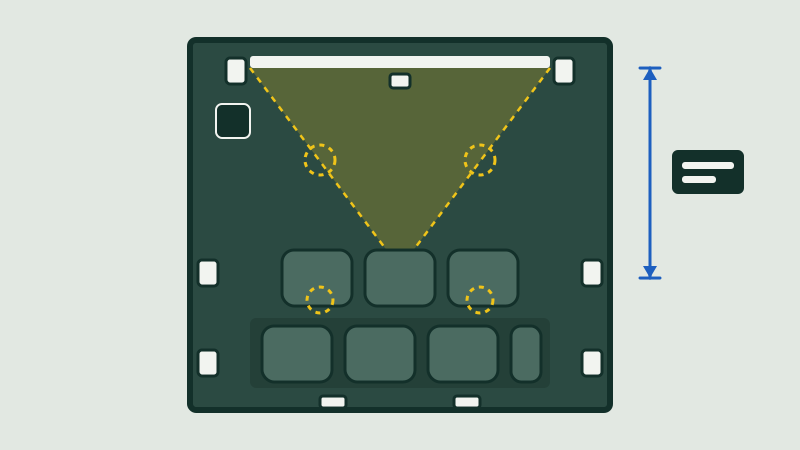
The two common guidelines are based on viewing angle. SMPTE recommends that the screen fills at least 30 degrees of your field of view, and THX recommends about 40 degrees for a more immersive picture. In practice that puts the main seats about 1.2 to 1.6 times the screen’s diagonal away. For a 100-inch screen, that’s roughly 10 to 13 feet.
Media rooms usually end up toward the farther end of that range, because the seating also has to work for conversation. Dedicated theaters can sit closer.
Speaker layouts
Speaker layouts are named by the number of main speakers, subwoofers and overhead speakers. A 5.1 system has five main speakers and one subwoofer. A 7.1.4 system adds two more surrounds and four overhead speakers for Dolby Atmos.
For most media rooms, 5.1.2, with two overhead speakers, is the sweet spot. It fits around furniture and delivers most of the overhead effect. In a dedicated room, 7.1.4 is a sensible baseline, with more speakers only if the room is large.
Light, sound and the room itself
In a media room, the upgrades that matter most are motorized shades for daytime viewing, dimmable lighting with a one-button movie scene, and a few acoustic panels at the points where sound first reflects off the side walls.
In a dedicated room, construction does most of the work: dark, non-reflective finishes, a dedicated circuit for the equipment, quiet ventilation, and walls and doors that keep sound in. That’s why dedicated theaters cost what they do, and why they’re best planned during a renovation. If you’re in the New York area, home theater installers such as Nex AV can look at the room and tell you which of the two it suits before you commit.
Common questions
Can a media room use a projector?
Yes, if you can control the light. A projector paired with an ambient-light-rejecting screen copes better in a room that isn’t fully dark, but a large TV is still the more forgiving choice for daytime viewing.
How big does a dedicated theater room need to be?
There’s no fixed minimum, but a room of around 12 by 15 feet comfortably fits a screen, one row of seats and a 5.1 or 7.1 layout. A second row usually needs more length and a riser.
Is a soundbar enough for a media room?
A good soundbar with a subwoofer is a real step up from TV speakers, and it suits smaller rooms and rentals. Separate speakers give a wider, more convincing surround effect in larger rooms.
Do I need acoustic treatment?
A few panels help almost any room. A dedicated theater needs more, both to control echo inside the room and to stop sound reaching the rest of the home.
Next guideSmart home work in a NYC co-op: how approvals actually work
Read the next guide